It comes from Naples, and it shows
In Naples, pizza was never something you ate alone while walking. It's a round thing you set in the middle, share, and go with a glass and a conversation that stretches on.
What we brought back isn't only a recipe: it's that way of making a meal last. Everything else — the dough, the fire, the produce — exists for that.
What happens inside the oven
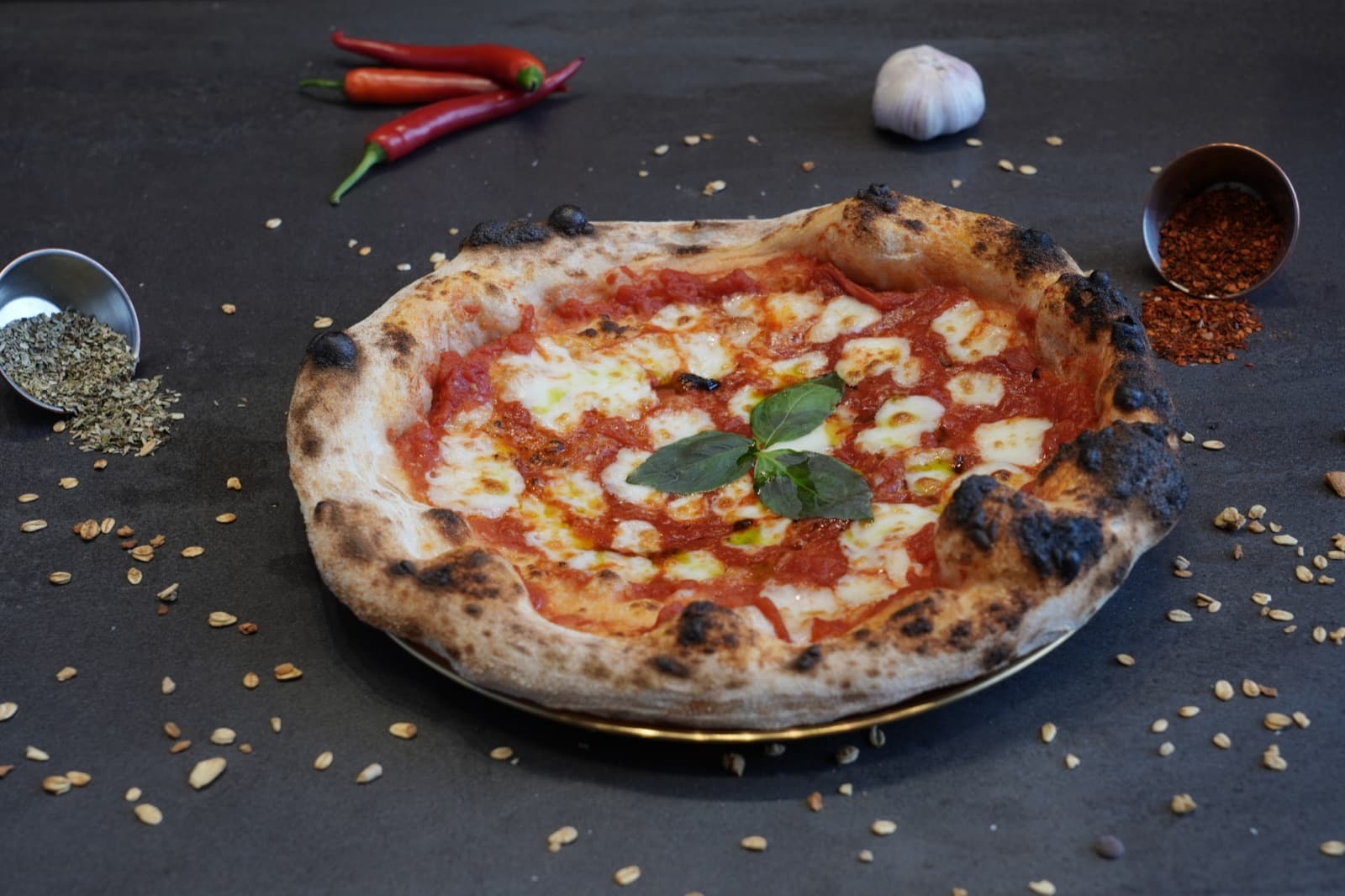
A Neapolitan bakes very fast, in a very hot wood oven. A minute and a half, barely time to finish a sentence. The rim swells at once, dark spots appear on the surface, the cheese melts just enough.
That short bake is what gives the contrast we're after: an airy, almost puffed rim and a centre that stays soft. An electric oven dries the dough before it colours it.
A dough that's easy to eat
The dough rests for a long time, cold, before being stretched by hand. You don't see that time on the plate, but you feel it afterwards: you finish a whole pizza without feeling heavy.
It's probably what we hear most at the end of a meal — and it's the compliment we're happiest with.
Few ingredients, but chosen ones
A good Neapolitan doesn't pile things on. An honest tomato sauce, a mozzarella that melts without flooding, fresh basil, a thread of olive oil: often that's all.
When there is so little, you taste each one. That's why we spend our time choosing rather than adding.
How to eat it
Straight away, while it's still hot — that's when it's best. In Naples people happily fold the slice in two and eat it by hand: nothing stops you doing the same here.
The centre of a Neapolitan stays soft. That's normal and intended. It isn't crisp from edge to edge; it's tender in the middle and airy around the rim.
And here, in Jerusalem
We make exactly that pizza in Talpiot, in a room designed for lingering, with a fully kosher menu under Mehadrin supervision.
So you can invite whoever you like, set the pizza in the middle of the table, and let the meal run long. That's precisely what it was invented for.